
Java Line Release and BOM Propagation
A patched artifact releases with every artifact in its line, and every supported BOM that pins the line releases again pinning the new version, so a recipient takes the fix by advancing one BOM version.
Relationship to parent
This profile extends REL-009 version 0.1.0. The tables are generated from the parent and profile metadata. Overrides specialize the parent obligation; inherited items apply unchanged.
Requirements
| Parent item | Treatment | Effective item | What changes or remains |
|---|---|---|---|
| REL-009.REQ-001 | Overrides | REL-009-JAVA.REQ-001 | Specializes the supported-scope declaration with Java lines, upstream baselines, member repositories, and pinning BOMs. The inherited adoption verification check records supported consumer entry points and tooling. |
| REL-009.REQ-002 | Overrides | REL-009-JAVA.REQ-002 | Specializes publication of an immutable remediation set by releasing every Java line member at a coordinated version, with checksums and pedigree. The inherited change-disclosure check preserves the generic evidence obligation. |
| REL-009.REQ-003 | Overrides | REL-009-JAVA.REQ-003 | Specializes the supported adoption procedure with bottom-up BOM propagation to every supported root. The inherited adoption verification check also verifies the resolved consumer result. |
Checks
| Parent item | Treatment | Effective item | What changes or remains |
|---|---|---|---|
| REL-009.CHECK-001 | Overrides | REL-009-JAVA.CHECK-001 | Checks the generic scope declaration against Java upstream BOMs and artifact sets; supported consumer configurations are also recorded by inherited REL-009.CHECK-006. |
| REL-009.CHECK-002 | Overrides | REL-009-JAVA.CHECK-002 | Checks the generic versioned remediation set through coordinated Java artifact versions, checksums, and pedigree. |
| REL-009.CHECK-003 | Overrides | REL-009-JAVA.CHECK-003 | Checks the Java BOM pin changes that implement the generic adoption procedure. Inherited REL-009.CHECK-006 verifies consumer resolution, while the added root check verifies propagation completeness. |
| — | Added | REL-009-JAVA.CHECK-004 | The fix has reached every supported root |
| — | Added | REL-009-JAVA.CHECK-005 | Every member's repository is a patch fork of the upstream that ships it |
| REL-009.CHECK-006 | Inherited | REL-009.CHECK-006 | Applies unchanged from the parent. |
| REL-009.CHECK-007 | Inherited | REL-009.CHECK-007 | Applies unchanged from the parent. |
Structured Requirements
Patch providers must publish a line declaration in the line's repository naming the BOM or the artifact set that defines the line, its members, the patch repository each member is released from, its upstream baseline, and the supported lines whose BOMs pin it.
| Check | Severity | Evidence |
|---|---|---|
|
REL-009-JAVA.CHECK-001 Line declaration is present and complete against the upstream baseline |
blocking | line_declaration, baseline_bom, pinning_bom_poms, line_members |
|
REL-009-JAVA.CHECK-005 Every member's repository is a patch fork of the upstream that ships it |
blocking | line_declaration, member_repositories, fork_parents, member_scm_addresses |
A patch must release every member of its line at the line's next patched version, whether or not each member changed, shipping unchanged members as the upstream bytes with rewritten metadata.
| Check | Severity | Evidence |
|---|---|---|
|
REL-009-JAVA.CHECK-002 Every line member is published at the release version, unchanged members byte for byte |
blocking | line_release_version, member_artifact_versions, member_checksums, baseline_checksums, member_pedigree |
After a line releases, every supported line whose BOM pins it must release at its own next patched version, with the BOM pinning the new version and no other managed version changed, bottom-up until every supported root has released.
| Check | Severity | Evidence |
|---|---|---|
|
REL-009-JAVA.CHECK-003 A BOM release pins the current release of every supported line it manages and changes nothing else |
blocking | bom_pom, previous_bom_pom, bom_pin_diff, pinned_line_releases |
|
REL-009-JAVA.CHECK-004 The fix has reached every supported root |
blocking | vulnerability_statement, root_release_versions |
Profile scope
REL-009-JAVA extends REL-009 for Java package releases consumed through Maven and Gradle. The parent defines the consumer outcome; this profile specifies line releases and BOM propagation as the Java mechanism. Java releases MUST preserve the parent obligations for declared scope, immutable release identity, supported adoption procedures, resolution verification, and change and validation disclosure through the specializations and inherited checks below.
Requirements 001–003 and checks 001–003 specialize their same-number parent items. Java checks 004 (root propagation) and 005 (member repositories) are additional checks. Parent checks REL-009.CHECK-006 (consumer resolution) and REL-009.CHECK-007 (change and validation disclosure) apply unchanged. Their numbers leave room for the five Java checks already proposed in PR #67.
The parent remediation set is represented here by the immutable line releases, member coordinates, published BOM pins, and associated release evidence. Adoption evidence identifies the supported Maven parent, Maven BOM-import, and Gradle configurations and tooling versions. For each supported configuration, it records the consumer edit, resolved versions before and after adoption, and whether the intended remediations were selected. A BOM’s published pins alone do not establish the resolved result in a consuming build.
This profile remains a draft for OSERA-SP-0.2.0. The Java check IDs previously proposed as REL-009.CHECK-001 through 005 become REL-009-JAVA.CHECK-001 through 005; draft implementation bindings likewise move from osera-fitness.rel009.* to osera-fitness.rel009_java.*. Implementers must update those draft bindings and emitted check IDs together; no ratified pack is changed by this split.
Requirement
Patch providers MUST publish a line declaration in the line’s repository. The declaration MUST name the patch repository each member is released from, and each of those repositories MUST be a fork of the upstream that ships the member, named and laid out under FORK-001.
A patch MUST release every member of its line at the line’s next patched version, whether or not each member changed. Unchanged members MUST ship upstream’s bytes with only their metadata rewritten.
After a line releases, every supported line whose BOM pins it MUST release at its own next patched version, with the BOM pinning the new version below it and nothing else changed, bottom-up until every supported root has released. A patch is not aligned until the roots have released: REL-009-JAVA.CHECK-004 fails on a lower line’s release until a release of every supported root names its vulnerability, so providers run the gate when the last root has released, not when the first line publishes.
Lines
Spring Framework 5.3.39 is 22 artifacts, spring-core, spring-web, spring-webmvc and 19 more, published together at one version, plus a BOM, spring-framework-bom, that lists all 22 at 5.3.39. Rather than pin those 22 one at a time, Spring Boot’s BOM sets one property, spring-framework.version, and imports the Framework BOM at that version, so an application that imports Boot’s BOM takes all 22 from that one property.
This standard calls that unit a line: the artifacts an upstream project releases together under one version, and the BOM, if the project publishes one, that names them. Upstream builds and tests a line as a unit, downstream BOMs version it with a single property, and so a patch has to move it as a unit. A line takes one of two shapes.
A BOM line is a BOM and the artifacts it manages at its own version. spring-framework-bom is one; so is jackson-bom 2.13.5 with the 64 artifacts it manages through ${jackson.version}. The members do not have to share the BOM’s version string. reactor-bom 2020.0.47 ships reactor-core 3.4.41 and reactor-netty 1.0.48, and it is still one line, because upstream releases them together and a downstream BOM takes them together by importing it.
An artifact line is a set of artifacts released at one version with no BOM of their own. Tomcat publishes tomcat-embed-core, tomcat-embed-el, tomcat-embed-websocket, tomcat-embed-jasper and the rest of org.apache.tomcat.embed:* and org.apache.tomcat:* at one version, and Spring Boot manages every one of them through tomcat.version. The property does the job a BOM would.
A single artifact that a BOM pins on its own is not a line. Boot manages snakeyaml through snakeyaml.version, but nothing else is released at that version to move with it. Such an artifact is patched at its own coordinate with its own counter, and the BOM that pins it re-pins it, exactly as it would take a new upstream release.
Which lines a patch supports
A patch request under REL-006 names the lines it wants patched; OSERA Wave 1 named Spring Boot 2.7, Spring Framework 5.3 and Spring Security 5.7. The request implies more: every line a requested BOM pins in which an in-scope vulnerability names an artifact. Wave 1 implied twelve, from Tomcat to Logback. Together these are the supported lines: the ones released whole, and the ones whose BOMs release again when a line beneath them moves.
Baselines
Each line stands on a baseline: the last release upstream made in that series, not the version a downstream BOM happens to pin. Boot 2.7.18 pins Framework 5.3.31, but upstream went on to publish 5.3.39, so the Framework line begins at 5.3.39 and every patch to it sits on top of every fix upstream shipped. A recipient who advances to the patched Boot moves Framework from 5.3.31 to 5.3.39 and the patch in one step.
Versions
A release of a line is one counter, shared by the BOM and every member, in the REL-003-JAVA form. Each member keeps its own baseline version in front of the counter: spring-data-bom 2021.2.18.1-osera-00003 pins spring-data-commons 2.7.18.1-osera-00003, and the shared 00003 says they were released together. The counter and its tag live on the line’s own repository under FORK-003, which for a BOM line is the BOM’s repository.
Which fork releases a member
FORK-001 says how a patch repository is named and where it lives: patch-<upstream repository>, a fork of the upstream, in the organization. It does not say which of a provider’s repositories a given artifact is released from, and a line’s members do not all come from one repository. Spring Data 2021.2 has 19 members from more than a dozen upstream repositories; Jackson 2.13 has 62 from some twenty. The exchange has inferred the repository from the uploaded POM’s scm address, or from a parent POM of the same group on Central, and fallen back to patch-<artifact> when neither carries a GitHub address. That inference fails where upstream writes the address elsewhere: Jetty’s org.eclipse.jetty.http2, org.eclipse.jetty.websocket and org.eclipse.jetty.fcgi modules have their parents in another group, every log4j 2 module’s parent names Apache’s gitbox, Jackson’s jackson-datatype-jdk8 and jackson-datatype-jsr310 ship from jackson-modules-java8 and spring-data-jdbc from spring-data-relational, names no POM carries. Each falls back to patch-<artifact>, a repository that cannot exist: GitHub allows one fork of an upstream per organization, and FORK-001.CHECK-002 compares the name with the fork’s parent. Under the Wave 1 lines, 59 of 331 members resolve that way.
The declaration settles it. Each member is released from the patch repository the declaration names for it, the line’s own repository unless the declaration says otherwise. The exchange resolves the repository for an uploaded artifact from the declaration of the line that lists it, and falls back to the POM-derived name only for an artifact no declaration lists. FORK-001 remains the rule for how the repository is named and laid out; this standard says which repository an artifact belongs to.
Because the line releases whole, a fork exists for every member’s upstream, whether or not the provider changed anything there. An unchanged member’s repository carries the release tag and the evidence file like any other, and its test provenance points at the release that carried the fix, as REL-001 provides for a release that changes no source.
Propagation
Three relations join lines, and only one of them releases anything:
- A pin is a version in a BOM’s
dependencyManagement: an entry, a property, or an imported BOM. Whoever imports the BOM takes that version at every depth of their dependency graph. When a pinned line releases, the pinning BOM releases too. - A declared dependency is the version in a member’s own POM, what it was built against. Maven carries it transitively, but any BOM in the consumer’s build overrides it, so nothing releases for it.
- A use is a package the member’s bytecode references with no declaration a consumer resolves, optional or provided. Nothing releases for it either.
Declared dependencies and uses say what to test when a line moves. Pins say what to release.
Releases run bottom-up so each BOM names final numbers, and each release has one cause: one source change for one vulnerability, or one re-pin of a lower line to one version, which closes every vulnerability that version closes. A root is a line nothing pins; a line pinned by two roots releases on both.
Because a root’s counter climbs once per cause anywhere beneath it, a root version is not a claim that the line is clean. spring-boot-dependencies at -osera-00030 with no Boot code changed is the expected shape. Release evidence and feeds under FEED-001 say which vulnerabilities each version closes, and only those.
OSERA Wave 1
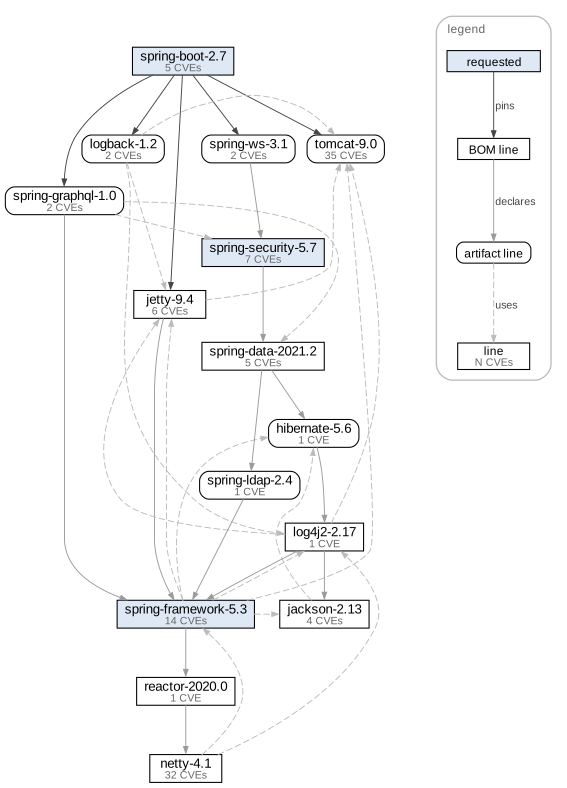
Fifteen lines carried the OSERA Wave 1 vulnerabilities. The three filled boxes are the lines the request named; the other twelve are supported because a requested BOM pins them and a Wave 1 vulnerability names one of their artifacts. Rectangles are BOM lines, rounded boxes are artifact sets, and the count is the Wave 1 vulnerabilities in each line. Dark arrows are pins, read upward: Boot pins all fourteen lines below it directly, so every fix in the picture ends in a Boot release. Grey arrows are declared dependencies and dashed arrows are uses; they shaped the test matrix and released nothing.
Each cause, a source change for one vulnerability or a re-pin of one lower line, became one release of its line and one of Boot. The 121 vulnerabilities came to about fifty Boot releases, most of them republishing Boot’s own 68 modules byte for byte with a rewritten BOM.
What recipients do
Versions below are illustrative, in the REL-003-JAVA form; they are not an inventory of published releases. In each example, CVE-2025-24813 in tomcat-embed-core was closed by re-pinning the Tomcat line to upstream 9.0.99, which released Boot as 2.7.18.1-osera-00004.
A Maven application under the Boot parent edits one version:
<parent>
  <groupId>org.springframework.boot</groupId>
  <artifactId>spring-boot-starter-parent</artifactId>
  <version>2.7.18.1-osera-00004</version>
</parent>
That edit moves tomcat.version to 9.0.99 for tomcat-embed-core, tomcat-embed-el, tomcat-embed-websocket and tomcat-embed-jasper together, and every other supported line to the version this Boot release pins. The build declares nothing about Tomcat.
A Maven application with its own corporate parent imports the BOM instead, and makes the same edit:
<dependencyManagement>
  <dependencies>
    <dependency>
      <groupId>org.springframework.boot</groupId>
      <artifactId>spring-boot-dependencies</artifactId>
      <version>2.7.18.1-osera-00004</version>
      <type>pom</type>
      <scope>import</scope>
    </dependency>
  </dependencies>
</dependencyManagement>
A Gradle application moves the plugin version, because the plugin is a member of the Boot line and imports spring-boot-dependencies at its own version; an application using platform("org.springframework.boot:spring-boot-dependencies:...") moves that coordinate instead:
plugins {
    id 'org.springframework.boot' version '2.7.18.1-osera-00004'
    id 'io.spring.dependency-management' version '1.0.15.RELEASE'
}
An application on Spring Framework without Boot imports spring-framework-bom, and a Framework fix reaches it as 5.3.39.1-osera-00001 at that one coordinate, moving all 22 Framework artifacts. Framework’s BOM pins no third parties, so an application on Framework alone already pins Tomcat with a property of its own, one for the whole line, and moves that property to 9.0.99. An application importing spring-security-bom alone takes Security’s fix the same way and pins Framework itself, because Security’s POMs keep declaring the upstream Framework version and a declared dependency releases nothing.
Rationale
Recipients adopt patches through the coordinates they already declare, and both kinds of coordinate work. An application that depends on spring-web directly takes the patched spring-web at the same coordinate, one version edit, and its declared dependencies bring the rest of the Framework line along at the same counter. An application that declares a parent or a BOM takes the fix through that parent or BOM, one version edit again, because the line and every BOM above it were republished. Without that republishing, the second application threads the fix through its stack by hand, differently in every build, and ends up with an override block that records which artifacts had vulnerabilities rather than what the application depends on. Republishing moves that work to the provider, once, where it can be checked.
The cost is one release per BOM above each cause, most of it metadata. Under the Wave 1 graph that is one Boot release per cause, which is why every release names its cause: the counter alone cannot say what changed.
The checks block rather than observe because a provider who skips them saves nothing; the work moves to every recipient, in the override blocks and precedence contests the alternatives below describe. The gate is the one place it can be paid once.
Evidence
The line declaration lives at the root of the patch branch in the line’s repository, the fork that carries the counter and tag under FORK-003. Its format is for the working group; its content is the BOM or the artifact set, the members, the repository each member is released from, the baseline, and the supported lines whose BOMs pin the line:
line: tomcat-9.0
artifacts:
  - org.apache.tomcat:*
  - org.apache.tomcat.embed:*
members:
  - org.apache.tomcat.embed:tomcat-embed-core
  - org.apache.tomcat.embed:tomcat-embed-el
  - org.apache.tomcat.embed:tomcat-embed-jasper
  - org.apache.tomcat.embed:tomcat-embed-websocket
  - org.apache.tomcat:tomcat-annotations-api
  - org.apache.tomcat:tomcat-jdbc
  - org.apache.tomcat:tomcat-jsp-api
repository: patch-tomcat
baseline: 9.0.121
pinned-by:
  - spring-boot-2.7
A BOM line names bom in place of artifacts, and may name excludes, artifacts the BOM manages at its own version that the line leaves out.
repository is the line’s own patch repository, the one that carries the counter and tag, and the one every member is released from unless repositories lists it under another. A line whose members ship from several upstream repositories lists each of the others with the members it releases:
line: jackson-2.13
bom: com.fasterxml.jackson:jackson-bom
repository: patch-jackson-bom
repositories:
  patch-jackson-core:
    - com.fasterxml.jackson.core:jackson-core
  patch-jackson-databind:
    - com.fasterxml.jackson.core:jackson-databind
  patch-jackson-modules-java8:
    - com.fasterxml.jackson.datatype:jackson-datatype-jdk8
    - com.fasterxml.jackson.datatype:jackson-datatype-jsr310
    - com.fasterxml.jackson.module:jackson-module-parameter-names
REL-009-JAVA.CHECK-001 reads the declaration against upstream on Central. Every member exists at the baseline. For a BOM line, every artifact the BOM manages at its own version is a member or excluded, so an omission cannot pass for a decision. For an artifact line, every artifact a pinning BOM manages through the line’s property is a member.
REL-009-JAVA.CHECK-005 reads the declaration against GitHub. repository and every key of repositories name a repository in the provider’s organization that GitHub records as a fork, named patch- followed by its parent’s name as FORK-001 requires. Every member is released from exactly one of them. Where a member’s own POM states a GitHub address for itself, that address is the parent of the repository the declaration names for it, so a declaration cannot move an artifact away from the project that ships it. A member that states none is placed by the declaration alone, which is the case this standard exists for.
Only an address the member states for itself governs, and only where it names a repository and stops there. An address a member inherits from a parent POM is the parent project’s statement, not the member’s; and Maven derives a module’s url and scm from its parent’s by appending the module’s artifactId, so an address carrying a path under a repository is that derivation rather than a statement, whether the module leaves it to be resolved or a flattened POM publishes the resolved value in the module’s own <scm>. org.springframework.data:spring-data-r2dbc is the shape: its POM on Central says https://github.com/spring-projects/spring-data-build/spring-data-parent/spring-data-r2dbc, two module segments hung off the address spring-data-parent inherits from spring-data-build, while the module’s source is in spring-projects/spring-data-r2dbc and spring-data-build ships none of it. Read as the module’s own address it refuses the declaration that places the module correctly and leaves no repository the module could be released from at all. The exchange takes the repository for an uploaded artifact from the declaration that lists it.
REL-009-JAVA.CHECK-002 reads the release. Every member exists at the release version. An unchanged member’s jar checksum equals the baseline’s on Central, and the CycloneDX document beside it carries a pedigree whose ancestor is the baseline release and no patches; a changed member’s pedigree lists each backport with the vulnerability it resolves. The check needs no jar, because the checksums are published with it.
REL-009-JAVA.CHECK-003 reads a BOM release and the release before it. The diff of managed versions names only supported lines, and each is pinned at that line’s current release.
REL-009-JAVA.CHECK-004 reads the feed. The OpenVEX statement for the vulnerability the release closes names a release of every supported root that pins the line, directly or through the lines between. On a lower line’s release it fails until the roots have released.
Each artifact’s CycloneDX component SHOULD carry its line and release as properties, osera:line and osera:release, and a BOM’s component SHOULD carry one osera:cause per vulnerability its release closes and a pedigree note saying whether a member changed or which lower line was re-pinned and at what version. These are for the reader with only a root number; the checks read the POMs, checksums and feed.
Alternatives considered
Each alternative below gives up one requirement and is measured on the same application as above, a Boot 2.7.18 build taking the Wave 1 fixes: what it edits, and what its build then says.
Patching one artifact of a line
Suppose CVE-2025-24813 had instead been fixed by publishing tomcat-embed-core alone at 9.0.121.1-osera-00001. Boot manages tomcat-embed-core, tomcat-embed-el, tomcat-embed-websocket, tomcat-embed-jasper, tomcat-jdbc and the rest through the one property tomcat.version. Moving the property fails to resolve, because tomcat-embed-el does not exist at that version. Leaving it means a per-artifact override for tomcat-embed-core alone and a runtime of Tomcat modules at two versions that Tomcat never released or tested together. Every downstream BOM that manages the line through a property has the same problem, and every recipient solves it differently.
Releasing the whole line removes the problem at its source. tomcat-embed-el at 9.0.121.1-osera-00001 is upstream’s 9.0.121 jar byte for byte with a rewritten POM, disclosed as such in its pedigree, so a scanner that matches by hash still sees the 9.0.121 jar. A version that exists for every member is what lets one property, and one BOM above it, carry the fix.
Publishing only the patched coordinates
Had only the patched coordinates been published, the same Boot application would carry the Wave 1 fixes as overrides, one per line that had a vulnerability, found and maintained by hand:
<properties>
  <tomcat.version>9.0.99</tomcat.version>
  <spring-framework.version>5.3.39.1-osera-00001</spring-framework.version>
  <spring-security.version>5.7.14.1-osera-00001</spring-security.version>
  <jackson-bom.version>2.13.5.1-osera-00002</jackson-bom.version>
  <netty.version>4.1.135.Final</netty.version>
  <spring-data-bom.version>2021.2.18.1-osera-00001</spring-data-bom.version>
  <hibernate.version>5.6.15.Final-osera-00001</hibernate.version>
  <!-- and jetty, log4j2, logback, reactor-bom, spring-ldap, spring-ws, spring-graphql -->
</properties>
Every property is a coordinate that had a vulnerability, spelled the way this one build shape allows. The block works only under spring-boot-starter-parent: a property in an imported BOM resolves inside the BOM, so the BOM-import application needs a dependencyManagement entry per artifact placed ahead of the import, and the Gradle application needs ext['tomcat.version'] under the dependency-management plugin or a constraint per artifact under platform(). Each property moves again whenever its line moves again, nothing in the build says which vulnerabilities the current set of numbers closes, and a fifteenth line found later changes the block in every application in the estate.
An aggregator BOM per line
The other way to give recipients one number is for FINOS to publish it: an osera-bom-spring-boot-2.7 whose dependencyManagement lists every patched coordinate, released once per cause like the Boot line itself, and imported by the application next to the Boot BOM it already uses. Producers then publish only what they changed, and no jar is republished byte for byte.
<dependencyManagement>
  <dependencies>
    <dependency>
      <groupId>org.finos.osera</groupId>
      <artifactId>osera-bom-spring-boot-2.7</artifactId>
      <version>2.7.18-osera-00004</version>
      <type>pom</type>
      <scope>import</scope>
    </dependency>
    <dependency>
      <groupId>org.springframework.boot</groupId>
      <artifactId>spring-boot-dependencies</artifactId>
      <version>2.7.18</version>
      <type>pom</type>
      <scope>import</scope>
    </dependency>
  </dependencies>
</dependencyManagement>
Two BOMs now manage the same coordinates, and which one wins is the build tool’s decision, made differently in each build shape. Maven takes the first import that names a coordinate, so the block above works and the same block with its two imports swapped changes nothing, without a warning. Under spring-boot-starter-parent the application imports the overlay and inherits Boot’s management, and Maven prefers an inherited direct entry to any import: the overlay wins spring-web, which Boot manages through an imported spring-framework-bom, and loses tomcat-embed-core, which Boot manages with a direct entry. That application keeps Boot’s own Tomcat pin with CVE-2025-24813 open, and only mvn dependency:tree says so. Gradle’s platform() turns both BOMs into constraints and resolves each coordinate to the higher version, and the dependency-management plugin applies a precedence rule of its own.
Boot’s own modules are direct entries at a literal 2.7.18, so under the parent the overlay cannot deliver any of Boot’s five Wave 1 fixes. Boot’s Maven and Gradle plugins take no version from any BOM; they are members of the Boot line and move only when the parent or plugin version moves.
The application is left tracking two numbers whose relationship it has to know: the overlay is built against one Boot patch level, and which of its entries take effect depends on the build shape and the order of two imports. Republishing the Boot line puts the patched pins in the one BOM the application already reads, where there is no second BOM to lose to. What the overlay saves is publication, one POM per cause instead of Boot’s 68 modules republished byte for byte, and this standard takes that cost, because a republished jar is disclosed once in its pedigree and a precedence contest is fought again in every application.